
A few blogs ago I wrote about the colour white, the use of it in fashion and society. I love colour and our Resource Centre allows me to indulge in a visual feast every time I do a display. A few weeks ago our display focus wasn’t on a particular period in fashion history, instead we chose to do a rainbow theme in the garment and accessories displays we arranged.


I think the topic of colour fascinates me almost as much as does the history of fashion and its social implications. Colour is such an integral element of fashion and our choice of colour is always personal (whether we recognize it or not).
For this blog I am going to focus on purple. The colour has been one that has been associated in western culture with royalty and nobility. The scarcity of the raw material found in nature to create purple caused its cost to be high. As a result garments which would be dyed this colour would be available only to those with the wealth to afford it. And as a result came to be a signifier of status.

During the 19th century and the industrial revolution the creation of aniline or chemical dyes changed all that. Now any colour could be created and the most desirable shade for members of the rising middle class was the colour that had previously represented those of higher social status.
Purple is a colour that swings on the pendulum of fashion trends. When it is fashionable it is very popular and when we have had enough of it the colour becomes gauche.
During the 1960s the colour palette we saw in fashion was comprised of more secondary colour – green, orange and purple – than primary colours (with the exception of yellow). These bright colours were the representation of the psychedelic ‘60s. Juxtaposing purple with yellow or with other colours like green and orange which are made with yellow made this an incredible bright colour story and one that was quite at odds with the elegant black, white, navy blue and “Dior” red of the previous decade.

As the fashion pendulum swung to the natural fibres and earthy tones of the 1970s, purple fell out of favour. We saw some purple return in the 1980s’ jewel tones in power dressing. And, in the minimalism fashion styles of the 90s and 00s any appearance of purple was used in deep tones or greyed tones.
Purple also seems to be a colour that individuals will be passionately in love with or they will be in the group who would “never be caught dead wearing it”. We have seen it come in the faintest of tints and the deepest of shades.
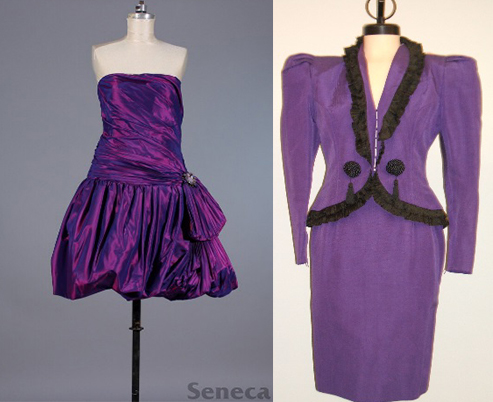
From a psychology of colour perspective, purple can be seen as representing royalty (which may be why Cadbury chocolate continues to use purple in its branding) and elegance – the majesty of a king’s royal robes.

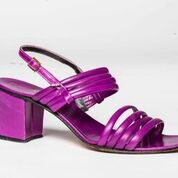
As a secondary colour it is created with red and blue and so is a blending of a warm and a cool colour. It is also created using the passionate nature of red and the calming influence of blue. No wonder it is interpreted as a colour of mystery, spirituality and enjoyed by very creative individuals.
Within our collection we have some examples of purple which are particularly representative of these different interpretations. From the iconic Victorian dress to strappy sandals when purple is on display attention is certainly generated.
